

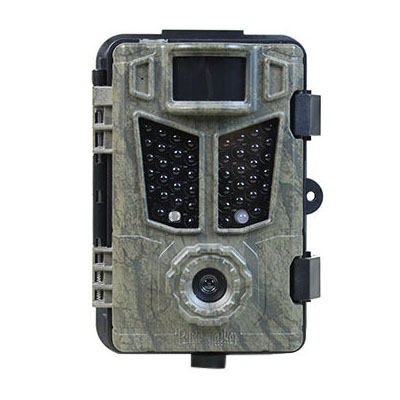
Trail cameras – the Robot D30 model
Among all the camera traps we have tested in the field, the Robot D30 stands out for its excellent value for money. This trail camera mounts a standard lens, therefore suitable for medium-field shooting, that is the most advisable solution for various types of use generally speaking. The Robot D30 camera traps are equipped with IR LED illuminators (invisible light).
1) Programmable resolution at 3/5/8/12/16 Megapixel with high quality interpolation.
2) Full HD 1080P 30FPS video with sound.
3) The “Camera + Video” mode allows you to take one or more photos and the video in succession at each shooting.
4) 44 infrared LEDs, with setting options to 20 LEDs in 3 modes: weak, normal and strong light. Invisible light (940nm LED wavelength).
5) Very high trigger speed (0.5 seconds).
6) 2.4 “TFT color screen to view images and videos.
7) Option to block any image you consider important to avoid deletion.
8) Ability to take up to 6 consecutive photos.
9) 7 exposure modes, the user can choose the brightness conditions of the photo in advance according to the characteristics of the environment.
10) The timer allows the camera to operate in a specific time interval.
11) In PIR Sleep mode the camera does not shoot the same subject several times.
12) In interval mode, the camera takes photos and videos at a specified interval. This is very useful for shooting a blooming flower or birds building a nest, for example. This function can be used with the timer function.
13) Auto Power Off in 1-10 minutes
14) Date, time, temperature and moon phase can be reported in the image.
15) Support SD card up to 64GB.
16) Low consumption and extremely long battery life (in standby mode, up to 6 months with 8 AA batteries)
17) Password protected camera lock.
18) Automatic shooting of color photos by day and monochrome by night.
Trail cameras or camera traps
Trail cameras, also called camera traps, are systems for automatically photographing an animal crossing a track and passing in front of the camera, without any need of the physical presence of the operator. They are widely used for wildlife management (censuses, monitoring, etc.) in natural parks, but camera trapping also has applications in research, in cryptozoology and, obviously, in nature photography.
Field of use of trail cameras
The specialty of trail cameras is monitoring and controlling the presence of the species in a specific territory, an area in which camera traps can be a valid help to classic detection techniques (sighting, traces search, acoustic calls, etc.) . In recent years, the increase in their quality has also allowed their use to estimate the density of mammalian populations. Other applications of camera traps are census, species recognition, fence and access control, hunting, surveillance.
The quality of trail cameras images and videos
Commercial photographic traps, of course, cannot return an image quality equal to that produced by professionals in the sector who normally use other tools, among other things much more expensive, in addition to their skills and experience, but this does not mean they aren’t able to produce pretty good photographs and interesting videos. Certainly the thrill of “seeing” what happens in a forest when men are far away is always very great.
Trail cameras – the models
We are presenting here models of trail cameras that we tried and tested in the field exclusively, models that we consider particularly advantageous for quality / price ratio and resistance to atmospheric agents. Among the features that, based on our experience, we consider of fundamental importance and that distinguish these models from competing ones we highlight the low activation time of the camera from stand-by (about 1 sec.), the small size, the high definition, the low absorption that allows a long battery life, the possibility of using cards up to 64 Gb for long monitoring.
Important note: all trail cameras produce color images during the day and black and white images at night, due to the infrared illuminators used.